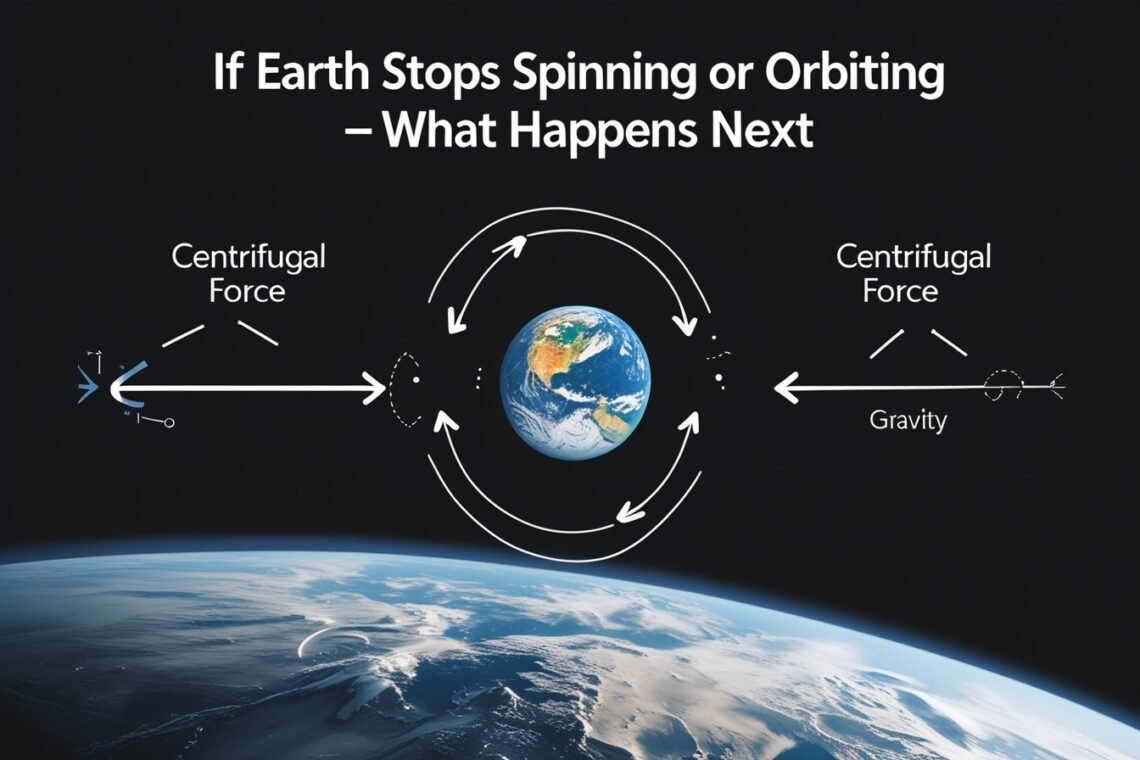
Imagine a world where Earth suddenly stops moving, no more spinning, no more orbiting the Sun. The idea sounds straight out of a science fiction movie, but it sparks curiosity about what could happen if our planet lost its natural motion. Right now, Earth is in a delicate dance with gravity and inertia that makes life possible. If that balance vanishes, what are the consequences? This article digs into the science and explores what might happen if Earth becomes completely still.
The Science Behind Earth’s Rotation and Orbit:
How Earth Moves: Rotation and Orbit Explained:
Earth spins on its axis once every 24 hours. This rotation creates day and night, giving us a rhythm to life. At the same time, Earth orbits the Sun once every roughly 365.25 days. This orbit keeps Earth at the right distance for life to thrive. The forces behind these movements include gravity, which pulls Earth toward the Sun, and inertia, which keeps it spinning forward in space. NASA’s data confirms that these motions are stable due to natural laws that have been in place for billions of years.
Why Earth Keeps Spinning and Orbiting:
The reason Earth continues its spin and orbit is mainly due to angular momentum, a property that keeps planets in motion. Think of it like a spinning top. Once spinning, it tends to keep going unless something forces it to stop. Gravitational pulls from the Sun and the Moon also play a role in maintaining Earth’s current path. Experts like astrophysicists say that planetary motion is incredibly stable thanks to these forces, making sudden stops impossible under natural conditions.
What Would Happen if Earth Stopped Spinning:
Immediate Effects of a Sudden Spin Halt:
If Earth suddenly stopped spinning, everything not tied down would fly forward at the original speed of about 1,670 km/h at the equator. That means massive tsunamis, earthquakes, and atmospheric chaos would occur instantly. Buildings, trees, and even mountains would be torn apart by the sudden inertia. Imagine a giant board sliding off a table, that’s what inertia does to everything on Earth if it were to stop cold.
Long-term Environmental Changes:
A world without rotation would mean one side permanently basking in the Sun’s heat, while the other end remains in darkness forever. Temperatures on the sunlit side would soar, making it unlivable, while the dark side would freeze into an icy wasteland. Climate patterns would be thrown into chaos, destroying ecosystems and making agriculture impossible. The familiar cycle of seasons and weather would vanish overnight.
Impact on Earth’s Atmosphere and Oceans:
Earth’s atmosphere and oceans rely on rotation to create weather patterns and ocean currents. Without spinning, these flows would weaken or stop entirely. This would cause dramatic shifts in climate, leading to dense atmospheric layers and altered weather systems. Ocean life, which depends heavily on currents, could face extinction as habitats disappear or become uninhabitable.
Effects on Tidal and Magnetic Systems:
Tides are caused by the gravitational pull of the Moon and Sun, which are affected by Earth’s rotation. If Earth stops spinning, tidal patterns would become irregular or vanish completely. Marine life that depends on tides for feeding and breeding could collapse. Furthermore, Earth’s magnetic field, generated by movements in its core, might weaken or shut down. This would expose us to dangerous solar radiation, increasing the risk of cosmic radiation reaching the surface.
What Would Happen if Earth Stopped Orbiting the Sun:
The Immediate Impact of Orbital Halt:
The idea of Earth suddenly stopping orbiting the Sun is highly theoretical and practically impossible without outside forces. If it hypothetically occurred, Earth would drift away from the Sun, losing the source of heat and light we rely on. Temperatures would plummet rapidly, and the planet would become a frozen wasteland.
Climate and Ecosystem Collapse:
Without sunlight, photosynthesis would halt. Most plants and animals would die rapidly. The ocean would freeze, and the atmosphere would thicken with cold, dense gases. Life on Earth would resemble the environments observed on moons like Europa or Titan, icy, dark, and inhospitable. This would lead to mass extinctions that could wipe out most known life forms.
Gravitational and Astronomical Consequences:
If Earth somehow stopped orbiting the Sun, it could disturb the entire solar system. Other planets depend on the Sun’s gravity to stay in their paths. Removing Earth from its orbit might slightly perturb the orbits of Mercury, Venus, and Mars. Over time, this could threaten the stability of the entire planetary system, although these effects would take millions of years to unfold fully.
Impact on Human Life and Civilization:
Without the reliable cycle of day and night, agriculture would collapse overnight. Power grids, infrastructure, and daily routines would face chaos. Long-term survival would be a huge challenge, with humanity forced to endure extreme cold, darkness, and resource shortages. The basic premise of civilization as we know it could vanish in a heartbeat.
Scientific Theories and Expert Perspectives:
Scientists agree that the likelihood of Earth suddenly stopping or changing orbit is virtually zero. Computer models confirm our planet’s stability is extremely resilient, thanks to natural laws that have held for billions of years. Experts like planetary scientists stress that such scenarios are purely hypothetical, impossible under the current understanding of physics. Our planet’s natural motion is a finely balanced dance that sustains all life.
Actionable Tips and Preparations:
While these scenarios are purely theoretical, understanding planetary stability is crucial in fighting climate change and natural disasters. Promoting sustainability, conserving resources, and supporting space research strengthen our ability to manage Earth’s health. Space agencies worldwide are working to protect Earth from asteroid impacts and other threats that could alter our planet’s delicate balance.
Conclusion:
The thought of Earth stopping its spin or leaving its orbit highlights how fragile our planet’s life-support system truly is. The consequences would be catastrophic and wipe out almost everything we cherish. Luckily, Earth’s motion is remarkably stable, thanks to natural laws. Protecting that stability requires scientific knowledge and global effort. By staying aware, we can better appreciate the planet’s resilience and work toward ensuring our world remains a safe home for generations to come.
FAQs:
1. What would happen if Earth stopped spinning suddenly?
Everything on the surface would be thrown forward at high speed, causing massive destruction, tsunamis, and atmospheric chaos.
2. Would one side of Earth always face the Sun if it stopped spinning?
Yes, one side would overheat under constant sunlight, while the other would freeze in permanent darkness.
3. How would Earth’s atmosphere and oceans be affected?
Weather patterns and ocean currents would collapse, leading to extreme climate shifts and loss of marine life.
4. What if Earth stopped orbiting the Sun?
Earth would drift into space, lose heat and light, and quickly become a frozen, lifeless world.
5. Would the Moon and tides be affected if Earth stopped moving?
Yes, tidal patterns would be disrupted, harming ecosystems and marine species that rely on regular tides.
6. Is it possible for Earth to suddenly stop spinning or orbiting?
No, experts confirm that natural laws keep Earth’s motion stable, making such events virtually impossible.